
The report said that Pakistan will retain its capabilities for the foreseeable future as a necessary deterrent against perceived existential threats from India.

Defence Minister Rajnath Singh lauded the armed forces' performance during Operation Sindoor, emphasizing the importance of technology and adaptability in modern warfare. He urged air force commanders to learn from the operation and stay prepared for future challenges.

US President Donald Trump claimed that "five jets were shot down" during the conflict between India and Pakistan in May and repeated his assertion that the fighting ended following his intervention. India has maintained that the two sides halted their military actions following direct talks between their militaries without any mediation by the US.
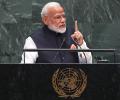
External Affairs Minister S Jaishankar will address the session on September 27

China is expected to boost its nuclear arsenal after President Xi Jinping's remarks at the key Congress of the ruling Communist Party in Beijing for the first time that Beijing will establish strong strategic deterrence, experts have said.
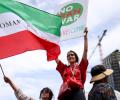
China and Russia on Sunday strongly condemned the United States air strikes on Iranian nuclear facilities, with China calling it a serious violation of the United Nations Charter that heightens tensions in West Asia, and Russia terming the strikes 'irresponsible' and asserting that they grossly violate international law, the UN Charter, and UN Security Council resolutions.
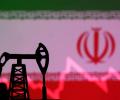
The Trump administration has sanctioned entities and individuals from India involved in sales of Iran's petroleum and petroleum products, saying the funds from this trade support Tehran's regional terrorist proxies and procure weapons systems that are a direct threat to the US.

Unless Donald Trump takes a major U turn, this is possibly the beginning of the end for Trumpian politics, argues Colonel Anil A Athale (retd). Unless President Trump takes a major U turn, this is possibly the 'beginning of the end' for Trumpian politics driven by TV trp's, points out Colonel Anil A Athale (retd).
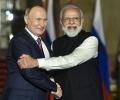
Notably, India has been calling for dialogue and diplomacy since the war began between Russia and Ukraine.

"Bad actors" cannot be allowed to have nuclear weapons at the cost of those trying to maintain peace and safety, United States envoy to the United Nations Nikki Haley has said.

India and Pakistan are reportedly expanding their nuclear arsenal, despite a global trend towards disarmament, the Stockholm International Peace Research Institute has said.

The study also said that the war would plunge the world into a "nuclear winter" that could lead to global climate catastrophe.

Although the credit for acquiring the technological skill must be given to India's outstanding nuclear scientists, the decision to go nuclear was a political one that entailed clarity of vision, courage and resolve, points out Rup Narayan Das.

'Imagine for a moment that the Coast Guard was unable to stop the vessel and it reached Porbandar with its cargo/personnel and targeted the event at which the prime minister was present,' says Colonel Anil A Athale (retd).

Stockpiles of the nations that are not recognised as nuclear weapon states under the Nuclear Non-Proliferation Treaty -- India, Pakistan, Israel and North Korea -- are minuscule in comparison with those of Russia and the United States.
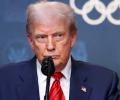
India and the US have collaborated through the past one month on launching a powerful satellite; are commencing joint production of GE Aerospace's F414 jet engines in India; India is participating in a massive three week-long military exercise in the Western Pacific, observes Ambassador M K Bhadrakumar.
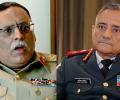
In the wake of the recent hostilities, both sides have moved from weapons to words, with India dispatching several delegations to visit more than 30 capitals across the world. A similar effort by Pakistan is set to start on Jun 2.
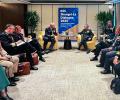
Top military officials from India and Pakistan highlighted their views at the Shangri-La Dialogue in Singapore, billed as Asia's premier defence forum, amid heightened tensions between the two sides following last month's military confrontation.

'This was undoubtedly a premeditated strategy to thwart India's entry into the NSG.' 'If India hopes to be a major player, it must use its rising clout on the world stage to influence amenable members of the group to alter such discriminatory practices and ensure fair rules of engagement,' says Vivek Gumaste.

Clinton slammed Trump for his alleged rhetoric on nuclear weapons.
Nuclear weapons have deterred world powers from issuing "explicit or implicit threats" to blackmail India to toe a particular line, National Security Advisor Shivshankar Menon said in New Delhi on Tuesday.

Russian President Vladimir Putin will make a two-day visit to India from December 4 to hold annual summit talks with Prime Minister Narendra Modi that is expected to produce a plethora of significant outcomes, including in the defence sphere, to further solidify the bilateral strategic ties.
The United States has imposed sanctions on at least half a dozen Indian companies accused of trading in Iranian petroleum and petrochemicals as part of broader action targeting 20 entities worldwide.

The crises of the 21st century, 9/11, the economic meltdown, COVID-19, Russia-Iran war and the Hamas-Israel war seem to be never ending. In this situation, Iran might be contemplating a nuclear deterrent to defend itself, observes Ambassador T P Sreenivasan, the distinguished long-time Rediff contributor who turns 80 on June 17..
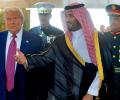
Acutely conscious that he's left with less than four years to create his legacy, Trump is undoubtedly a man in a hurry, observes Ambassador M K Bhadrakumar.

US Vice President JD Vance called on India to drop non-tariff barriers, give greater access to its markets and buy more American energy products and military hardware. Vance, in a speech in Jaipur, highlighted the need for a stronger US-India partnership for a prosperous and peaceful 21st century. He emphasized the importance of working together to address global challenges and praised Prime Minister Narendra Modi, describing him as a "special person." Vance also urged India to provide greater market access to American products and buy more defense platforms and energy from the US. He suggested that India consider dropping some of the non-tariff barriers for American access to the Indian market and highlighted the benefits of closer India-US defense collaboration, advocating for New Delhi to procure more military hardware from the US. He cited the example of American fifth-generation F-35s, arguing they would give the Indian Air Force the ability to defend its airspace and protect its people like never before. Vance also welcomed the Modi government's budget announcement to amend India's civil nuclear liability laws, paving the way for US producers to export small modular reactors and build larger US-designed reactors in India. He emphasized the importance of energy security for India's AI ambitions, stating "there is no AI future without energy security and energy dominance." Vance's visit comes amid growing global concerns over the US's tariff war.

We have nothing to gain by raising our concerns internationally as our narrative has got entangled with several controversial concepts in the United Nations, asserts Ambassador T N Sreenivasan.
Expressing concern over the continuing buildup of nuclear weapons in South Asia, the United States has asked India and Pakistan to restrain their atomic and missile programmes and play a positive role in the global non-proliferation community.

Putin said work would be completed on building storage units for tactical nuclear weapons in Belarus on July 1, a move he likened to US nuclear deployments in Europe.
After the terror attack on Mumbai in November last year exposed the vulnerability of the Indian coastline, Navy chief Admiral Sureesh Mehta on Wednesday said cargo containers could be used to transport nuclear weapons."We have to ensure 100 per cent security at ports by scanning them (containers) under X-ray machines. Every country has to accede to it that wherever, whichever port the container leaves from, that country certifies that this container is fully secure," he said.

Larsen & Toubro Ltd (L&T) is deepening its push into data centres and defence manufacturing while keeping an eye on emerging opportunities in nuclear and thermal power, chairman and managing director SN Subrahmanyan said. The engineering and construction conglomerate has invested around Rs 2,200 crore in data centres, with 32 megawatts (Mw) already operational.

North Korea will not use nuclear weapons against other nations unless its sovereignty is threatened, its leader Kim Jong-un has said.
India today welcomed the renewed global push for achieving a world free of atomic weapons but underlined that the international nuclear order cannot be "discriminatory".

"It is still not too late. India must speak clearly, act responsibly, and use every diplomatic channel available to defuse tensions and promote a return to dialogue in West Asia," Gandhi asserted.
President Barack Obama, in the coming years, will have to decide whether to deploy such weapons cutting the US reliance on nuclear weapons, the New York Times said in its report.
India has sought total elimination of nuclear arms backed by a security system in which states do not feel the need to develop, produce or stockpile them.

In its 28-page report, the CRS noted that Pakistan's nuclear arsenal is widely regarded as designed to dissuade India from taking military action against it, but Islamabad's expansion of its nuclear arsenal, development of new types of nuclear weapons and adoption of a doctrine called "full spectrum deterrence" have led some observers to express concern about an increased risk of nuclear conflict between Pakistan and India, which also continues to expand its nuclear arsenal.
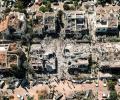
Trump has a major decision to take in coming days -- specifically, how to rescue Israel from the attritional war that lies ahead, points out Ambassador M K Bhadrakumar.

China's official media on Sunday criticised United States bomb attacks on Iranian nuclear sites as a further step toward the abyss, while experts in Beijing said the American bunker-buster bombs used in strikes may not be enough to destroy Iran's nuclear plants hidden deep underground.

He said Pakistan was working with the international community to ensure the security of its nuclear installations, which were always in safe hands.
